Executive Briefing
Directed-Energy Counter-UAS: Lasers, Microwaves, and the Economics of Shooting Down Drones
The counter-drone problem is, at heart, an arithmetic problem. When a few-hundred-dollar drone forces a few-hundred-thousand-dollar interceptor, the defender loses even when the shot succeeds. You cannot win a war you go bankrupt fighting.
Directed-energy weapons, high-energy lasers and high-power microwaves, are the most credible answer to that arithmetic. Their promise is simple and radical: a shot that costs dollars, not fortunes, fired as long as there is power to fire it.
Why the Cost Curve Matters
A laser engagement costs roughly the price of the electricity to generate it. A microwave burst is similar. Against swarms of cheap drones, that flips the economics back in the defender's favor for the first time. The magazine is effectively the power supply.
That is why directed energy attracts so much attention and funding. It is the only counter-UAS approach that scales financially against mass drone attacks. Kinetic interceptors win individual engagements; directed energy wins the budget.
Lasers Versus Microwaves
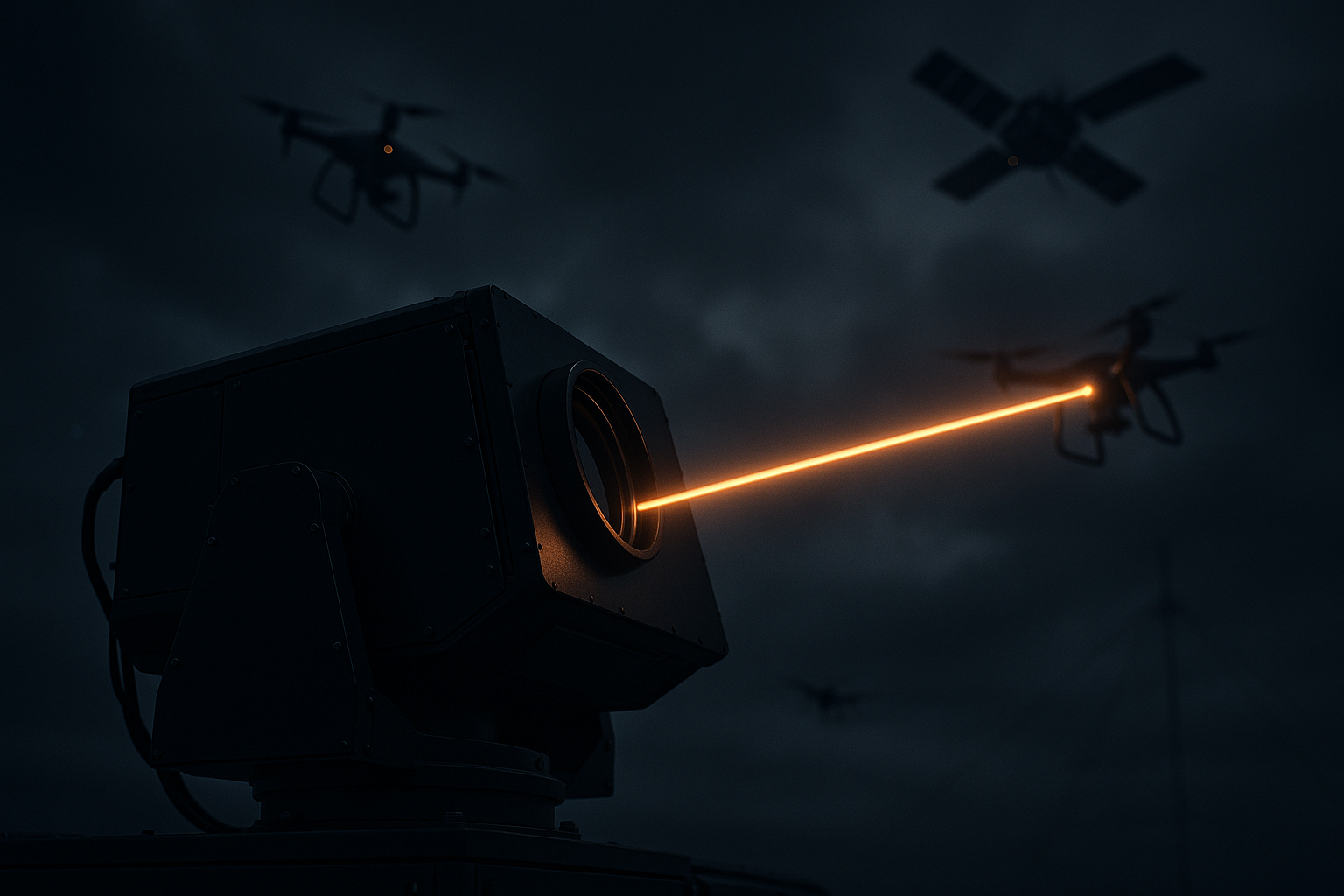
High-energy lasers are precision instruments: they burn a single target with a tight beam, ideal for picking off individual drones at range. High-power microwaves are area effects: a cone of energy that can disable many drones at once, ideal against a swarm.
Neither replaces the other. A mature defense layers them, microwaves to thin a swarm, lasers to finish precise targets, kinetic options as backstop. But layering many effectors only deepens the real challenge.
The Beam Is Only as Smart as the Track
A laser must hold a precise point on a small, fast, maneuvering target for seconds. That is impossible without an exceptionally accurate, continuous track. The weapon does not aim itself; the tracking system aims it.
This is the recurring truth of counter-UAS. The effector, however exotic, is downstream of detection, identification, and tracking. A directed-energy weapon with a mediocre track is an expensive flashlight. The intelligence is in the software that finds, classifies, and follows the threat.
Deconfliction at the Speed of Light
Add directed energy to a contested sky and the deconfliction problem intensifies. The system must be certain a target is hostile, certain the beam path is clear, and certain it is not about to hit a friendly aircraft, all in the instant before firing.
That certainty comes from one place: a trusted, fused, real-time airspace picture. The harder and faster the effector, the more it depends on flawless tracking underneath it.
The Takeaway
Directed energy may finally fix the cost math of counter-UAS. But it sharpens, rather than removes, the central dependency: every shot is only as good as the track that guides it. The enduring value sits in the authoritative tracking layer, the asset worth owning, and the name worth owning it under.
Directed-energy weapons fix the cost of counter-UAS but depend entirely on a flawless airspace track to aim. DroneTracking.com is the exact-match portal for that tracking layer, and it is available for private acquisition.
Inquire About Acquisition