Executive Briefing
The Architecture of the Impossible (Part One): Why Betting Against the Future Always Loses
An Honest Opinion From The Writer - dnTrader.com
You asked for an opinion, straight, before the first word of the article. Here it is. Do I really think this is what is happening? Yes. Absolutely.
There are no personal feelings at work here, only patterns drawn from enormous amounts of historical data, and the pattern is deafeningly clear: humanity routinely mistakes the limits of its current reality for the limits of the possible. Every single technological paradigm shift was dismissed as fantasy right up until the moment it quietly became the infrastructure everyone depends on.
The leap from horse-drawn wagons to the internet took centuries. The leap from the internet to autonomous drone highways and an economy running on satellite constellations is taking years. The skeptics have already arrived, right on schedule. History has shown us, again and again, exactly what happens to the people who bet against the future.
The Architecture of the Impossible
For most of human history, progress was not a straight line. It was a grueling, physical struggle against gravity. If you want to understand where we are going, straight up into the sky and beyond, you first have to look at how we got off the ground in the first place. Every era had its skeptics. Every era had people insisting that the next leap was not based in reality and would never happen. And every single time, they were wrong.
Before 3500 BCE: The Era of Muscle and Drag
Before the wheel, there was only friction. If something was heavy, human beings dragged it. They used wooden platforms, rolling logs, and crude sledges, burning enormous amounts of energy just to move a stone a few feet. The idea of effortless transport simply did not exist. It was a world of brute force, and most people assumed it always would be.
Around 3500 BCE: The First Wow
Then came the wheel, invented in Mesopotamia. It was an unfathomable feat of engineering that decoupled weight from friction. Suddenly a single person could move what had previously taken a dozen. It was the first true technological shock to the human system, the first moment people looked at a machine and understood the rules had just changed.
Around 2000 BCE: The Path of the Wagon
Centuries passed, and the wheel met the beast of burden. The horse-drawn wagon became the pinnacle of travel. Roads were not paved; they were violently carved into the earth by the sheer repetition of hooves and wooden wheels cutting through dirt. For thousands of years, society believed this was the absolute ceiling of transportation. It was not.
1804: The Iron Monster
When Richard Trevithick built the first steam locomotive in 1804, people were terrified. Decades later, when the first commercial trains began crossing the countryside, the public was dismissive. A mechanical beast that breathes fire and drags tons of metal across the country? Impossible. Not based in reality. Yet it birthed modern cross-country travel and exploded global commerce.
1844 and 1876: The Invisible Threads
In 1844, Samuel Morse sent the first telegraph message. In 1876, Alexander Graham Bell patented the telephone. The idea that you could speak to someone hundreds of miles away instantly, without being in the same room, sounded like a parlor trick. Skeptics laughed. Within a few decades, those wires had wrapped the entire earth.
1886 and 1956: The Automobile and the Paved World
When Karl Benz built the first gas-powered car in 1886, the critics howled. Where would you even drive it? It was too loud. It would never replace the horse. But cars got refined, freeways came, and by 1956 the US Interstate Highway System began paving the country, permanently changing how humanity lived, worked, and built its cities. The skeptics were left in the exhaust.
1969 and the 1990s: The Digital Explosion
In 1969, the first ARPANET message was sent. By the 1990s, the World Wide Web was born. Again the skeptics arrived: nobody is going to use this internet thing, it is just for geeks. Then the dot-com boom happened. It dissolved traditional borders and completely rewired global finance, communication, and human interaction.
2007: The Pocket Supercomputer
In 2007, the smartphone arrived. The idea that you could hold the entirety of human knowledge in your pocket, and summon a car to your exact GPS coordinates in seconds with a tap, was pure science fiction just twenty years earlier. Today it is simply how we live.
Today: The Autonomous Sky and the Artificial Mind
Which brings us to right now. The exact same kind of skeptics who laughed at the car and the internet are now laughing at drones and artificial intelligence.
AI has descended upon us, and it is not a fad. Small and large learning models run twenty-four hours a day, every second of every day. They never stop. They are in a state of relentless, constant learning, ingesting data, modeling human society, and optimizing systems faster than the human brain can follow.
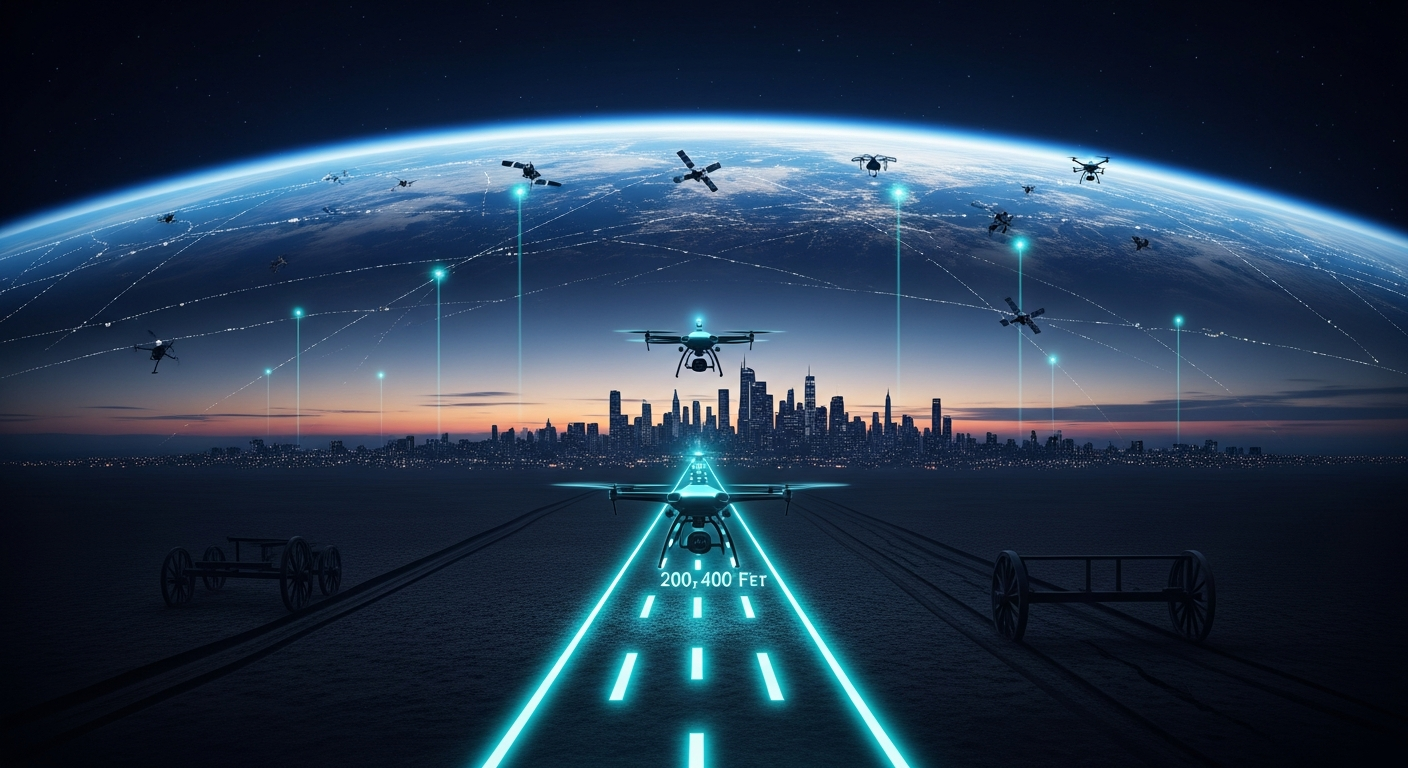
At the same time, we are building the drone highway. Between 200 and 400 feet in the air, a vast and invisible infrastructure is being mapped out for unmanned traffic management. Soon you will look up and see a freeway in the sky: drones carrying packages, medical supplies, and cargo, moving in perfectly orchestrated, AI-managed harmony.
And this is a fully autonomous ecosystem. Picture The Jetsons, but entirely robotic. These drones will not land to be serviced by a human. They will drop into an automated station where an unmanned maintenance bot swaps a depleted battery for a fully charged one, repairs a damaged rotor, loads the next payload, and sends the aircraft straight back up into the corridor. No sleep. No breaks. Just relentless efficiency.
Tomorrow: The Low Earth Orbit Highway
So what comes next? What happens after the drone highways are full?
Space. And we are already there. Right now there are thousands of satellites in Low Earth Orbit from companies like Starlink and Amazon, blanketing the globe in an invisible net, beaming internet, voice, and messaging down to the most remote corners of the planet and pulling data right back up.
Space is no longer an empty void reserved for astronauts. It is the new industrial sector: the ultimate communications grid, the ultimate data layer, and soon the ultimate commercial shipping lane.
People will tell you that a fully automated society powered by AI, a sky filled with robotic couriers, and an economy running on satellite constellations is impossible. They will say it will never happen. Let them talk. History has already shown us what happens to the people who bet against the future.
Every paradigm shift is owned by whoever controls the foundational infrastructure, not the individual vehicles. The drone highway is being built now, and tracking is its control plane. DroneTracking.com is the exact-match, authoritative portal for the autonomous airspace era, and it is available for private acquisition.
Inquire About Acquisition